


Late post, I know. It’s been a hectic couple days. A friend is sleeping on our couch (his dog is sleeping on our floor, his potted plants in most of the windows, etc.) while he’s in-between living situations and meanwhile the city of Chicago is glowing and alive again, full of a jostling, bustling energy enough to make any troglodyte feel fully human again after a long hibernation. I just returned from the Do Division street festival in Wicker Park and, now, after feeding the dog and drinking three or four glasses of orange juice, I’m feeling ready to write something up for this month’s readings.
But, before we get into the nitty gritty with W.G. Sebald, I’ve been hard at work putting the final touches to a secret side project which will be revealed in full next month. Apologies for not checking in with the blog and with the Substack crowd much in recent weeks; back in November-December, I burnt out rather badly on writing for the internet and in the early months of this year I threw myself into something completely different to try and regroup a bit. My head’s been in the clouds but the project is finally nearing completion and I’m excited to share it with all of you. That’s all I’m saying about it for now but if you’re still curious, you can keep an eye on this space.
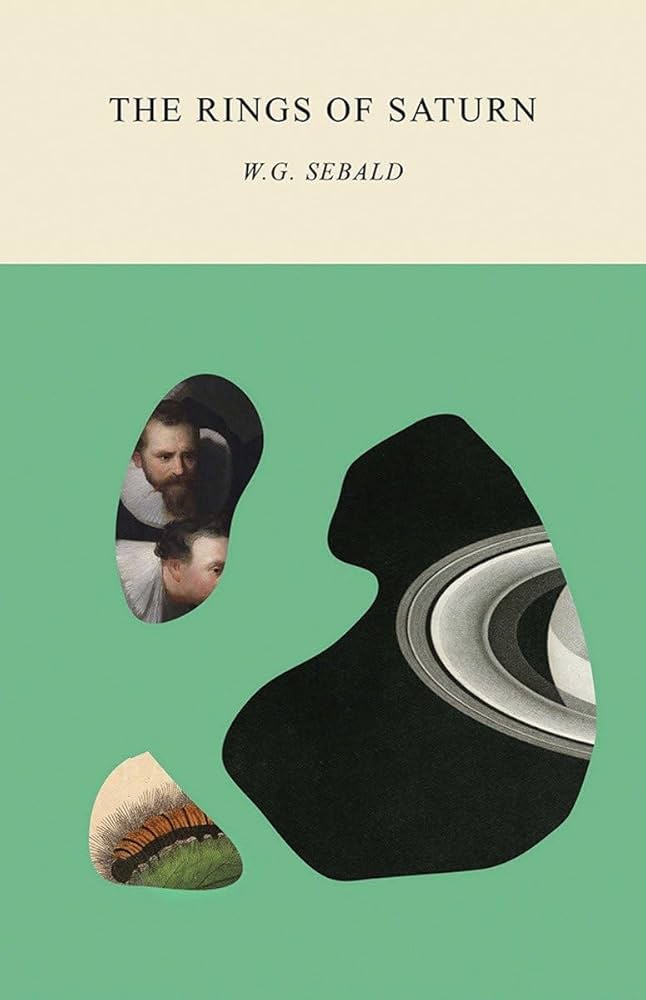
The Rings of Saturn — W.G. Sebald
“Three or four miles south of Lowestoft the coastline curves gently into the land. From the footpath that runs along the grassy dunes and low cliffs one can see, at any time of the day or night and at any time of the year, as I have often found, all manner of tent-like shelters made of poles and cordage, sailcloth and oilskin, along the pebble beach. They are strung out in a long line on the margin of the sea, at regular intervals. It is as if the last stragglers of some nomadic people had settled there, at the outermost limit of the earth, in expectation of the miracle longed for since time immemorial, the miracle which would justify all their erstwhile privations and wanderings. In reality, however, these men camping out under the heavens have not traversed faraway lands and deserts to reach this strand. Rather, they are from the immediate neighbourhood, and have long been in the habit of fishing there and gazing out to the sea as it changes before their eyes. Curious to tell, their number almost always remains more or less the same. If one strikes camp, another soon takes his place; so that over the years, or so it appears, this company of fishermen dozing by day and waking by night never changes, and indeed may go back further than memory can reach. They say it is rare for any of the fishermen to establish contacts with his neighbour, for, although they all look eastward and see both the dusk and the dawn coming up over the horizon, and although they are all moved, I imagine, by the same unfathomable feelings, each of them is nonetheless quite alone and dependent on no one but on himself and on the few items of equipment he has with him, such as a penknife, a thermos flask, or the little transistor radio that gives forth a scarcely audible, scratchy sound, as if the pebbles being dragged back by the waves were talking to each other. I do not believe that these men sit by the sea all day and all night so as not to miss the time when the whiting pass, the flounder rise or the cod come in to the shallower waters, as they claim. They just want to be in a place where they have the world behind them, and before them nothing but emptiness.” (51-52)
Everything goes. Everything grows and decays — but where, might we ask, does our life go after we’ve gone? Beyond spiritual platitudes, now putting our foot on a more stable, materialist sense, we can imagine most of the collection of our living goes to the landfills (and what is our life besides a collection of things, banalities, mundanities, moments?) — but then we must ask, in turn, at what point does the world itself become landfill? At what point does the accumulation of dead things outweigh the living?
At the start of May, I finally delved into the prose stylings of Mr. Sebald with his book The Rings of Saturn, a great novelish approach on the topics of death, decline, and the accumulation of waste.
Misguidedly, I approached the book like it was to be another nonfiction survey of English literature (which: fine), and around page 50 I realized (with a considerate hmph) that what I held in my hands was something murkier and stranger than any survey. It’s difficult to say what exactly The Rings of Saturn is, or what it’s about, and that, of course, is central to its appeal.
Like all (or most) truly great prose stylists, Sebald is first and foremost a master of the sentence form. His sentences, like you can read above, are beautiful little machines and where the going gets odd is in their accumulation, the spiraling out of a wandering mind avoiding something obvious which is never pointed at directly. The paragraphs wander on and on for pages at a time until disintegration from which a new thread emerges out from the wreckage.
It’s a fascinating, baffling style which beckons the reader on into the book’s winding corridors. The thrill of reading picking apart a mind like Sebald’s is in the blowing apart of readerly confidence. For a page or two, I would believe I had a solid notion of what the book in my hands was until the following section knocked me loose of any such confidence. In Sebald’s hands, the book form becomes an unknowable object pointing at shadows on the periphery; the topics pointed at, like Silkworm harvesting or the final years of the Chinese empire, for instance, are the obvious topics which are pointing to a greater accumulation in the world and, therefore, in the modern mind.
Like Borges, Sebald writes fiction disguised as nonfiction, but in stepping further away from that Argentine maestro, Sebald abandons any preoccupation with fiction’s narrative sense, abandons its characters and its structuring, instead utilizing nonfiction’s sense of narrative while still maintaining fiction’s hazy intent.
While I was writing these notes by the open windows of my apartment on a beautiful, albeit somewhat chilly, late May morning, the streets outside awfully quiet beside the occasional bird’s call, a food delivery robot trundled through the shadows of the silver maple trees across the street, humming its little song, and going about its business. I wonder what Sebald would have said about these little things. The mind wanders…
That all being said, The Rings of Saturn is perhaps the best book I’ve come across about the accumulation of colonial exploitation and its consequences, about the death drive inherent to the western world’s conception of itself and its place in history. These topics are nearly impossible to look at directly, and its in such a way that fiction and writing retains a certain power. And in a way there is a terribly sad injustice only a stone’s throw away from any moment, lurking in the periphery of everything we see. Where did these bananas in my kitchen come from? These coffee beans? The rare earth minerals in my iPhone? What will become of the landfills and the buildings?
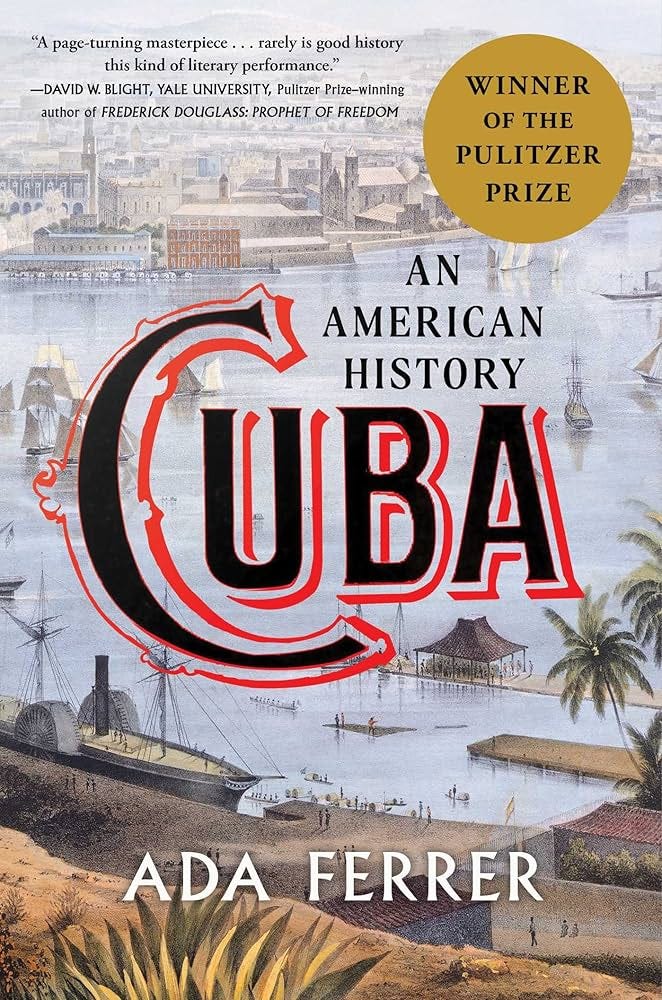
Cuba: An American History — Ada Ferrer
“One day, probably in September 1612, two Indigenous brothers named Rodrigo and Juan de Hoyos and a ten-year-old enslaved boy called Juan Moreno set out from that settlement with orders to bring back salt from the coast of the bay of Nipe. It was hurricane season, and bad weather forced the men to shelter overnight near a place known as Cayo Francés (probably after the French pirates who always threatened). Early the next morning, with the sea unusually still, the trio headed out in search of salt.
“Instead, they encountered a divinity. In the water, the men spied a white object floating in the distance. Juan Moreno, the young black boy, described the discovery some seventy-five years later as an old man. ‘Drawing nearer it looked to them like a bird and even closer, the Indian said that it looked like a Girl. And in this discussion, they got closer and recognized and saw the Image of Our Lady the Holy Virgin with a child in her arms standing over a small plank.’ One of the men leaned out over the edge of the canoe and used his hat to scoop up their unusual find. The statue was small, some four inches tall. the wood on which she stood had ‘big letters… and they said I am the Virgin of Charity. And they were astonished that although her garments were made of cloth they were not wet.’” (34)
