


I’ve been very one-track minded about apartment hunting these days, and the 95 degree weather in Chicago doesn’t help. The idea might be laughable to those of you in the southern states, those of you who I grew up with in Mississippi, but don’t you forget that in-unit air conditioning is not as wide-spread here as it is there. My window AC is chugging along the best it can.
This month has been something of a transitional moment for me, I finished cleaning up the audio for the first year of the razzle dazzle doom and gloom project, have everything edited, dialed in, and scheduled for release through this next year. It’s out of my hands now. A good feeling. You can listen to the first recording here. There will be 41 more on the way.
Since the razzle dazzle project was an attempt at clearing my personal slate — writerly burnout descended on me in December like the angry moon in Majora’s Mask — now it’s time to get back into the weeds with writing some stuff. Since I enjoyed putting together 50 songs to release like string cheese, stretched out over months and months, I find myself leaning towards writing 50-something blog posts and not releasing any until the whole batch is done—this might change, of course! But as of now that feels like a natural next step. I cut out caffeine too, this month, and not having that jolt in the morning means I will need to readjust how I approach the craft. There are also a couple short stories I would like to work on as well.
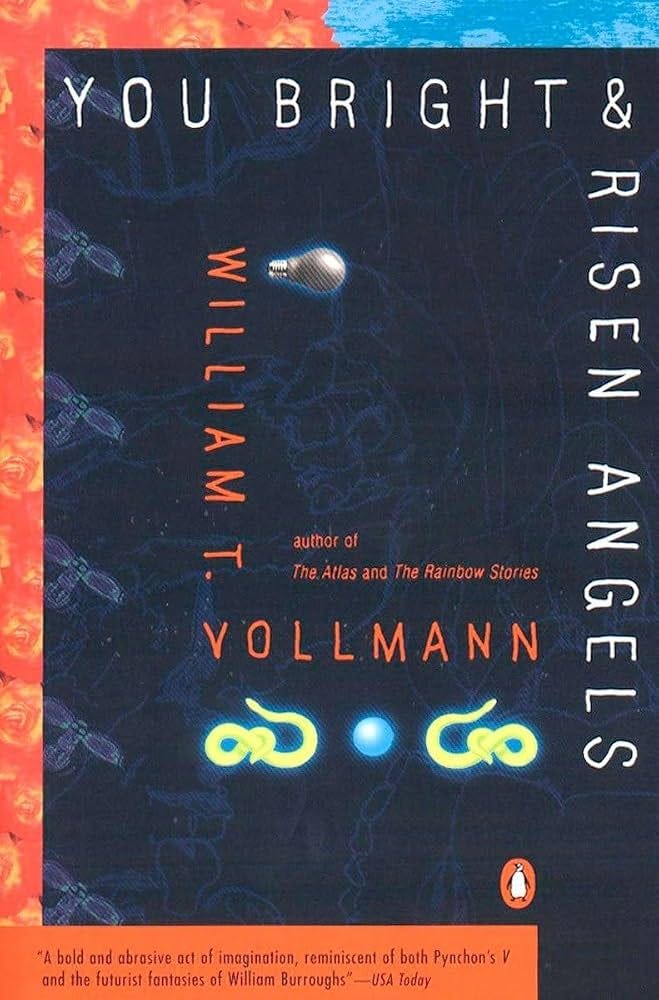
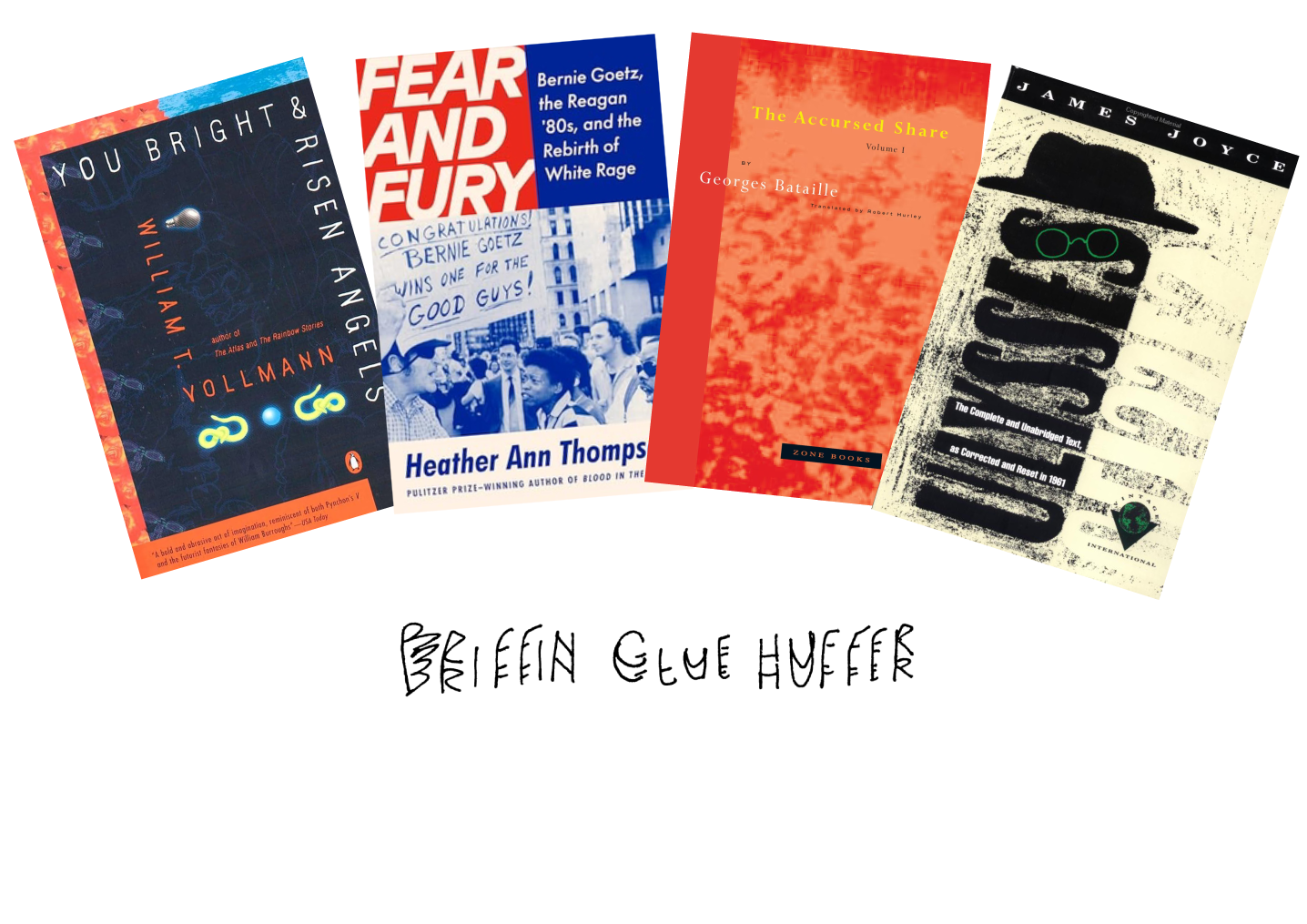
You bright and risen angels — Vollmann
“‘You won’t hurt me anymore?’ Tony said.
‘I wouldn’t hurt you,’ Bug said. ‘Here are your feelers if you can use them.’ They were flaking apart in his hands, like rolled flies’ wings.
‘They aren’t any use now,’ Tony sobbed. It was the death of his feelers in particular that seemed to upset him, much as a man whose family has been massacred and whose house has burned down will lament the consequent loss of his expensive sunday shoes. This focusing of grief, I have read, is a very effective defense mechanism.
‘Are you going to die?’ Bug said. He put the antennae in the wastebasket, quietly, so Tony wouldn’t hear, and wiped his hands on his pants.
‘My mother’ll eat me and start over. That’s what she always said she’d do if I blew it.’
‘Maybe she was just kidding you,’ Bug said. ‘Try to look on the bright side.’
‘It’s all right,’ Tony said. ‘I’ve seen her do it to other kids. It doesn’t hurt.’
‘Oh, well,’ Bug said. ‘That’s good.’” (152)
Vollmann is a talented writer — one of the more underrated fiction writers working in English today — and has a good sense of balancing the somber with the ridiculous. Here we have his first novel, one in which his talents are still forming, a book about the insects of the world (who are of variable size, obviously a stand-in for all of the persecuted peoples of the world) rising up against the forces of electricity (a stand-in for the hypercapitalism of the twentieth century — a very apt stand-in, I would say, and the best chapters of the work are those focusing on the despotic spread of electricity throughout the natural world), and the life of the revolutionary figure at the struggle’s center, a human named Bug who eventually turns his back on the Insects as he begins to become darker and darker, craving violence more and more. It’s as if Dune were written about creepy crawlers vs. corporate bureaucrats with a more comic tint. That’s to say it doesn’t work as well as Dune does, but it is fun to watch the young Vollmann give it a go.
I’ve had a fascination with Vollmann’s work since encountering his Rainbow Stories a couple years back — a book which blurs fiction and nonfiction by going through fringe communities throughout the Untied States, chapters ranging between sex workers to skinheads — and then Europe Central which I read two months ago and became terribly sad about. World War II books, if they’re honest, will mostly evoke a terrible sadness in the reader, flashes of Walter Benjamin’s Thesis on History flitting through their head like a dark ghost, all that.
That being said, Vollmann’s historical fiction is some of the best of the game and I very much need to read some of his Seven Dreams books about the interactions between native American tribes and European colonists, but that’s for a later day.
The book at hand here, You Bright and Risen Angels, is ambitious in a multitude of ways. It feels manic, scuttling, just as a book about an insect uprising should, I suppose. The story being told (or, programmed, as it’s referred to), in its actual narrative, is fought over between Vollmann and “Big George”, an ominous figure wresting the narrative towards his own telling, sometimes mid-sentence even, representing a possible stand-in for the complacent forces of human society’s apathy and willingness to squash and forget. When this technique works it works. There’s one wonderful sequence of an underwater fight between Bug and a couple of his high school bullies who come at him in the school’s pool with harpoons drawn. When it doesn’t work, though, it really doesn’t. Vollmann’s a passionate writer. Having read other books by him, I know this is true. But it’s clear looking at this first attempt at a novel that he was very much overrun by his own passions. Some strokes of brilliance but a lot of fluff. His talents weren’t smoothed out in those first years. Rome wasn’t built in a day. Two and a half stars out of five.

Fear and Fury — Heather Ann Thompson
“James and Darrell, still seated at the end of the car, had been watching the interaction unfold with some curiosity. Neither boy could hear much over the sounds of the train. James thought that Troy might be asking for the time. And while Darrell had no idea what they were saying, the whole situation made him nervous. Troy’s brash attitude could be sort of cool, but it could also really piss someone off.
Troy, however, was undaunted. He repeated, ‘How about giving us five bucks?’
Bernie Goetz stood slowly. He unzipped his jacket and turned as if to retrieve some cash, but instead, he suddenly spun around. Assuming a combat stance, he pulled a gun out of his waistband and began shooting.” (78)
